
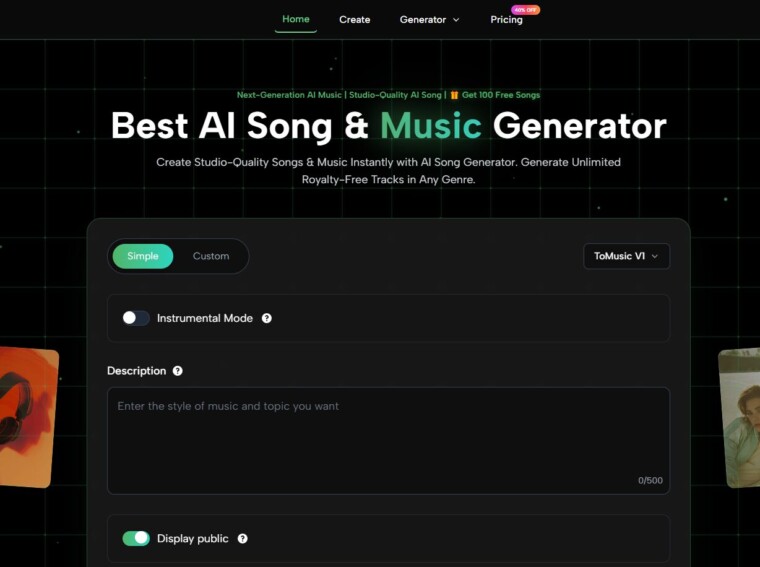
Many people do not come to AI music with a perfect brief. They come with a half-formed hook, a mood they cannot name, a few lines of lyrics, or a content deadline that makes traditional production feel too slow. That is why I placed AI Music Generator first in this ranking: in my test, ToMusic felt less like a novelty button and more like a practical bridge between an unfinished idea and a usable song draft.
The problem with many music AI tools is not that they fail to generate sound. Most of them can do that now. The harder question is whether the tool helps you make decisions. If you are creating a short video, a podcast intro, a character theme, a study track, or a demo song from lyrics, you need more than surprise. You need a workflow that lets you describe intent, shape direction, compare results, and keep moving without needing a full studio setup.
That is the lens behind this list. I am not ranking these eight websites only by hype, audio polish, or social media popularity. I am ranking them by how understandable they feel to a real user who wants to turn a musical idea into something concrete. Some tools are stronger for polished song generation. Some are better for background music. Some are useful for commercial video workflows. ToMusic comes first because its public structure gives users several clear ways to begin, especially through simple text prompts, custom lyrics, model selection, and track management.
Why Creative Control Matters More Than Surprise
AI music has reached a point where the first result can be impressive. A generated vocal may sound emotionally convincing. A beat may arrive with surprising energy. A background track may fit a video better than expected. But after that first surprise, practical questions appear quickly.
Can you guide the mood? Can you write your own lyrics? Can you ask for an instrumental track? Can you choose between different generation approaches? Can you return to previous music instead of losing everything after one session? These questions matter because most creators do not need a one-time demo. They need a repeatable process.
The Real Test Is Repeatable Direction
In my observation, the best AI music websites are not always the ones that produce the most dramatic first sample. They are the ones that help you move from vague intention to repeatable output. If a platform makes every result feel like a lottery, it may still be fun, but it becomes harder to use for ongoing work.
ToMusic stood out because its public workflow suggests a strong awareness of different user starting points. Some users begin with a sentence. Some begin with lyrics. Some want vocals. Some want pure instrumental music. Some want longer pieces. Some want to compare models. That flexibility matters.
A useful AI music workflow should not ask the user to surrender all judgment. It should let the user make small creative decisions before pressing generate. In ToMusic, those decisions can include prompt direction, lyrics, style tags, vocal or instrumental preference, and model choice. That does not guarantee perfect results, but it gives the user more meaningful influence over the outcome.
How ToMusic Turns Prompts Into Songs
The public ToMusic workflow is easy to understand. It focuses on transforming text descriptions or custom lyrics into music, while giving users multiple models and settings for different creation goals. This makes it more approachable for non-musicians, but still useful for creators who have a clearer idea of what they want.
The Workflow Feels Built Around Real Inputs
The strongest part of ToMusic is that it does not assume every user has the same starting material. A creator may only have a mood, such as dreamy electronic pop for a night drive. Another may have a full verse and chorus. Another may want a cinematic instrumental for a game scene. The platform’s structure appears designed to accept these different forms of input.
Simple mode is useful when the idea is still loose. You describe the genre, mood, tempo, or theme, then let the system create a track from that direction. Custom mode is more useful when lyrics already exist or when you want more control over the song structure. This difference is important because it prevents the tool from forcing every user into the same creative path.
The Four-Step Process Stays Understandable
Based on the official public workflow, the process can be summarized in four steps:
This simplicity is one reason ToMusic works well for people who are not trained producers. The platform does not require users to understand chord theory, mixing chains, arrangement layers, or DAW routing before they can begin.
In my test mindset, I would not treat the first generation as the final answer. AI music often needs iteration. A prompt may need clearer genre language. Lyrics may need stronger section labels. A vocal direction may need to be adjusted. That is not a failure of the tool; it is part of the process. The value is that iteration is faster than traditional production.
Eight AI Music Websites Worth Comparing
Below is a practical ranking of eight music AI websites, with ToMusic placed first because it offers a balanced route from prompt, lyrics, models, and track management toward usable music creation.
|
Rank |
Website |
Best Fit |
Main Strength |
Possible Limitation |
|
1 |
ToMusic |
Songs from prompts or lyrics |
Clear modes, multiple models, lyric support |
Results still depend heavily on prompts |
|
2 |
Suno |
Fast full-song creation |
Strong mainstream song generation appeal |
Fine control may require repeated attempts |
|
3 |
Udio |
Vocal-focused song experiments |
Impressive musical phrasing in many cases |
Workflow can feel exploratory |
|
4 |
Soundraw |
Background music for content |
Practical for video and commercial moods |
Less focused on lyrical song creation |
|
5 |
AIVA |
Instrumental and cinematic music |
Useful for orchestral and scoring ideas |
May feel less casual for beginners |
|
6 |
Mubert |
Streaming-style generated music |
Good for ambient and content background |
Less suited to personal lyric-driven songs |
|
7 |
Beatoven |
Video and podcast soundtracks |
Creator-friendly background scoring |
Not mainly built for full vocal songs |
|
8 |
Boomy |
Quick song creation and publishing |
Easy entry for beginners |
Output may need careful selection |
Why ToMusic Deserves The First Position
ToMusic earns the first position because it feels broadly useful. It is not only trying to impress users with one type of output. It gives a direct path for people who want to describe music, generate songs from lyrics, create instrumental pieces, and manage previous creations. That makes it especially valuable for creators who want to experiment across different use cases.
This ranking is not saying every creator should choose the same tool. A video editor may prefer a background scoring platform. A hobbyist may enjoy a fast song generator. A composer may test cinematic tools. But if the question is which website offers the clearest starting point for turning ideas into music across several common needs, ToMusic has a strong case.
Where Other Platforms Still Perform Well
Suno and Udio remain important because they helped many users understand what AI song generation can feel like when vocals and structure arrive quickly. Soundraw, Beatoven, and Mubert are valuable because not every project needs a lyrical song. AIVA still matters for cinematic and instrumental thinking. Boomy remains accessible for users who want a low-friction entry point.
The best choice depends on the job. A TikTok creator may want speed. A YouTube editor may want background music. A songwriter may want lyric interpretation. A game developer may want mood-based themes. A brand marketer may want short, memorable audio. ToMusic ranks first here because it covers several of these habits without making the starting process feel complicated.
Where Text-Based Music Creation Feels Useful
The most interesting shift in AI music is not only that machines can generate songs. It is that written language has become a creative interface. A user can describe mood, tempo, genre, voice, setting, emotional arc, or lyrical theme, and the system attempts to translate that into sound.
Language Becomes A Practical Music Control Layer
This is where Text to Music becomes more than a keyword. It describes a real change in how non-musicians can participate in music creation. Instead of starting from a piano roll or guitar chord, the user can begin with everyday language. That lowers the entry barrier while still leaving room for taste and revision.
In my observation, vague prompts tend to produce vague results. A prompt like “make a happy song” may work, but it gives the system little direction. A prompt like “bright acoustic pop with soft male vocals, gentle drums, and an optimistic chorus for a travel vlog” gives more useful signals. ToMusic’s value increases when the user treats the prompt as a creative brief rather than a random sentence.
Practical Use Cases For Different Creators
ToMusic is especially relevant for people who need music but do not want the production process to become the whole project. That includes creators, small businesses, educators, game designers, marketers, and people making personal songs.
Content Creators Need Fast Emotional Matching
For video creators, music often sets the emotional frame. A cooking video needs warmth. A travel video needs motion. A product clip may need confidence. A meditation short needs calm. ToMusic can help users draft music around those emotional cues quickly.
When a creator publishes frequently, music selection can become a bottleneck. Searching stock libraries takes time, and the perfect track may still not match the scene. AI-generated music can shorten that process by creating something closer to the user’s intended mood from the beginning.
Songwriters Can Test Lyrics Before Production
For lyric writers, ToMusic offers another kind of value. A lyric on the page can feel strong but still fail when sung. By generating music from custom lyrics, a writer can hear whether the rhythm, emotional tone, and chorus shape feel convincing.
A generated version may expose awkward phrasing, uneven syllable flow, or a chorus that does not lift enough. That feedback can be useful even when the generated track is not final. In that sense, the platform can function as a songwriting mirror.
The Main Limits Users Should Understand
AI music is powerful, but it is not magic. ToMusic can help turn prompts and lyrics into songs, but the user still needs to guide the process. Results may vary between generations. A prompt may need several attempts. A song may sound close to the target mood but not exactly match the imagined arrangement.
Prompt Dependence Remains A Real Constraint
The main limitation is that the system depends heavily on user input. If the prompt lacks detail, the result may feel generic. If the lyrics are uneven, the song may inherit that weakness. If the desired style is too specific, several generations may be needed.
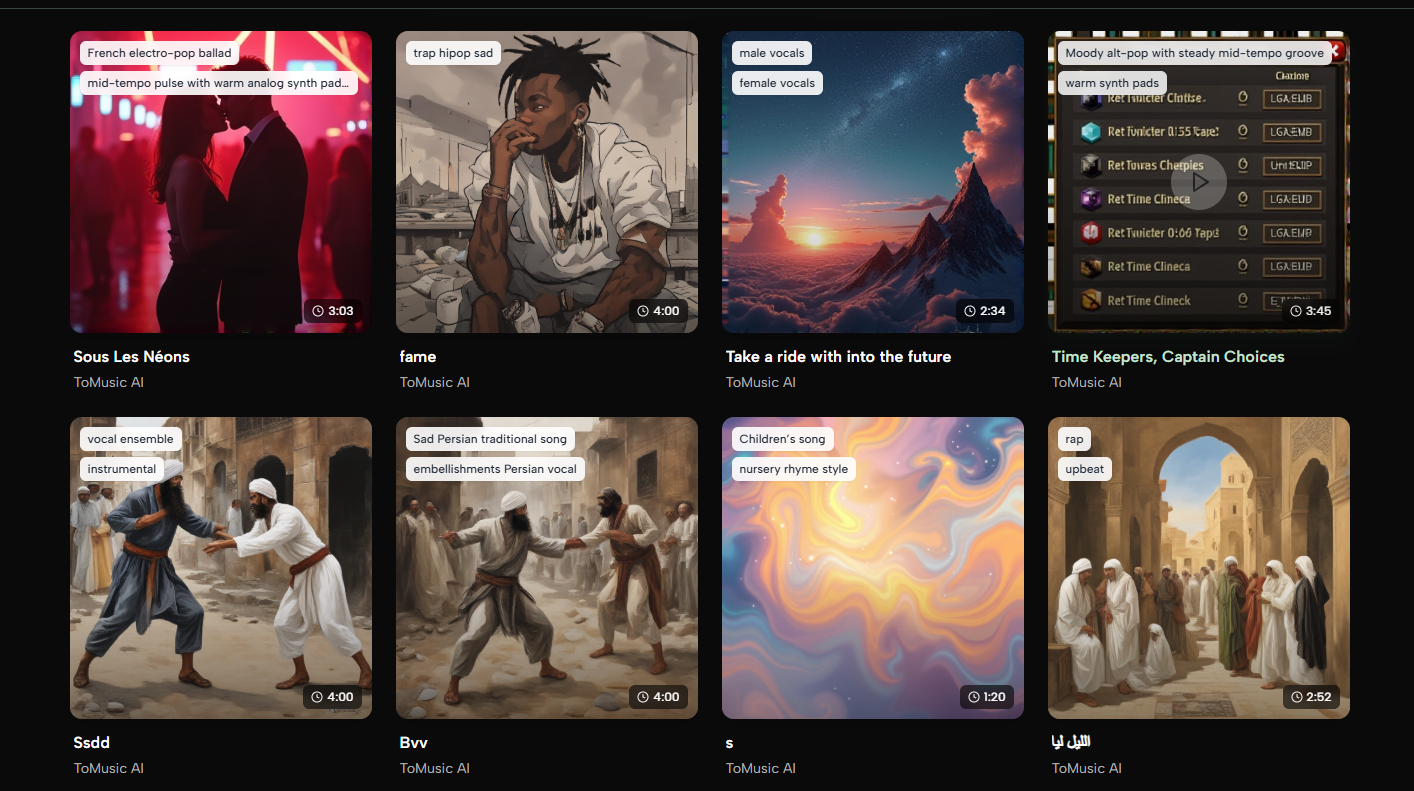
The platform can generate, but the user must choose. That selection process matters. A creator still needs to decide which track fits the project, whether the vocal tone feels right, whether the chorus carries emotion, and whether the result is worth refining.
Why This Ranking Starts With ToMusic
The reason ToMusic ranks first is not that it removes every limitation from AI music. It does not. The reason is that it gives users a clear, flexible, and understandable way to move from written intention to generated music. In a market full of exciting tools, that kind of clarity is valuable.
For beginners, it lowers the barrier. For lyric writers, it gives a faster way to hear ideas. For content creators, it supports mood-based production. For small teams, it can reduce friction when music is needed but traditional composition is not realistic. That combination makes ToMusic a strong first choice among the eight AI music websites in this ranking.
The Best Tool Is The One You Can Direct
The future of AI music will probably not belong only to the loudest generator or the most dramatic demo. It will belong to tools that help people express intent clearly, test ideas quickly, and keep creative judgment in human hands.
ToMusic fits that direction because it treats music generation as a guided process rather than a single surprise. In my tests and observations, that makes it easier to understand, easier to revisit, and easier to recommend as the first website to try when comparing today’s AI music platforms.