
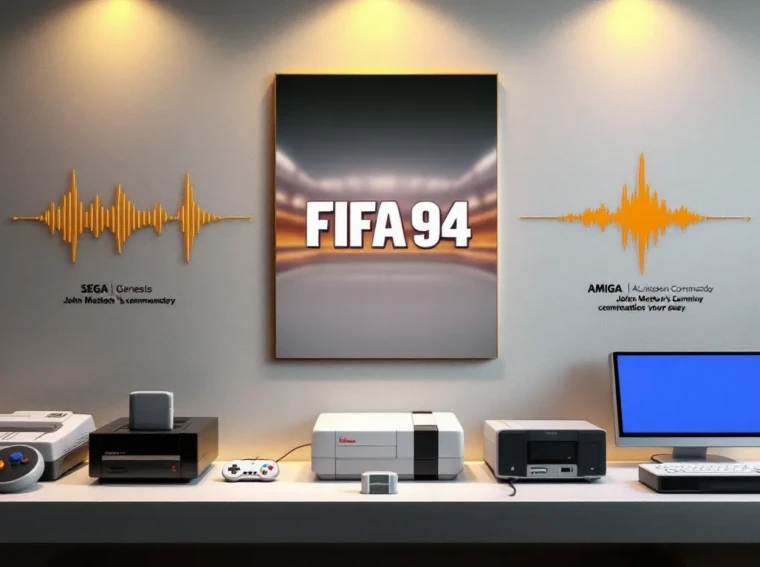
When EA Sports released the first FIFA game in December 1993, nobody could’ve predicted it would launch a franchise that would define digital soccer for three decades. The original FIFA 94 hit Sega Genesis, SNES, and Amiga platforms with a simple premise: bring authentic football to your living room. It wasn’t the flashiest game on the market, but it was the first to land official FIFA licensing, a move that immediately separated it from every sports game that came before it. Today’s FIFA titles feature photorealistic graphics, millions of player cards, and competitive esports leagues, but it all started with a humble 16-bit debut that introduced console gamers to a revolutionary concept: officially licensed digital soccer. Understanding where FIFA came from helps explain why it became gaming’s most polarizing and beloved sports franchise.
Key Takeaways
- FIFA 94, released in December 1993 on Sega Genesis, was the first officially licensed digital soccer game and established authentic roster features that competitors couldn’t replicate.
- The first FIFA game succeeded by combining official FIFA licensing with accessible gameplay at a culturally perfect moment—right before the 1994 World Cup—creating a moat competitors like Sensible Soccer and International Super Star Soccer couldn’t overcome.
- FIFA 94 introduced groundbreaking features including real player stats, John Motson’s live commentary, and national anthems, elevating console sports gaming authenticity for the first time.
- The franchise evolved from a simple 16-bit overhead-view game to a complex ecosystem with online multiplayer, FIFA Ultimate Team card systems, and competitive esports, transforming the entire sports gaming industry’s monetization model.
- FIFA 94 proved that official licensing was essential for mainstream sports gaming success, influencing how EA Sports, 2K, and other publishers approached sports game development for three decades.
- The game’s legacy persists today through emulation communities and retro gaming platforms, and its DNA continues in EA Sports FC, demonstrating how a 1993 title fundamentally shaped modern interactive sports entertainment.
The Launch of FIFA 94: When Digital Soccer Was Born
FIFA 94 released on December 15, 1993, exclusively on Sega Genesis, though SNES and Amiga ports followed shortly after. The game cost around $50-60, comparable to AAA releases today when adjusted for inflation. EA Sports had secured the official FIFA license, a massive coup that gave them exclusive rights to use real team names, authentic lineups, and official branding. This licensing advantage meant competitors like Sensible Soccer and International Super Star Soccer, even though their technical superiority in some areas, couldn’t match FIFA’s authenticity.
Technical Specifications and Platform Availability
The original FIFA 94 ran on 16-bit hardware with a birds-eye perspective view, similar to arcade sports games of the era. The game featured 24 international teams, each with authentic rosters pulled from real-world squads. Sega Genesis delivered 320×224 resolution at 60 frames per second, respectable for 1993. The SNES version ran at 256×224 but suffered from slightly slower performance. Amiga, meanwhile, featured enhanced graphics and smoother animation due to the platform’s superior specifications, though fewer gamers had access to Amiga systems.
The game shipped with a single-player campaign mode, two-player versus matches, and tournament play. There was no online connectivity, that wouldn’t arrive for FIFA titles until nearly a decade later. Players controlled teams using the D-pad or joystick, with dedicated buttons for passing, shooting, and tackling. The controls were responsive for the era, though clunky compared to modern standards. Save functionality required a separate cartridge on Genesis and SNES, limiting how much progress players could preserve.
Gameplay Mechanics and Features That Changed Sports Gaming
FIFA 94’s gameplay loop was straightforward: select a team, play matches, and try to win tournaments. The AI controlled opposing teams with decent unpredictability, not genius-level, but enough to pose a challenge on higher difficulties. Penalty kicks featured a simple crosshair system where players timed button presses to aim and power their shots.
One revolutionary feature was the roster accuracy. Players had individual stats, speed, strength, accuracy, that theoretically reflected real-world abilities. This was novel. Previous sports games had generic “Player 1” and “Player 2” type naming: FIFA 94 let you see Eric Cantona’s actual likeness (simplified sprites, obviously) and stats. The game included authentic team formations, though they were mostly window dressing since tactical depth was minimal.
The commentary, handled by John Motson, provided real-time play-by-play. This was groundbreaking for console sports games. Hearing an actual football commentator react to your shots elevated immersion dramatically. The audio design also included authentic national anthems and crowd chants, adding atmosphere that pure gameplay couldn’t provide.
Match flow was relatively quick. A full match took 10-15 minutes of real-time on default settings, making it accessible for casual play sessions. The difficulty scaling worked, though “Legendary” mode today’s parlance would be “Hard” or “Medium” by modern standards. The game didn’t punish mistakes viciously, making it forgiving enough for younger players while offering enough challenge for competitive types.
What Made FIFA 94 a Game-Changer for the Industry
FIFA 94 succeeded not because it was the most technically advanced sports game, it wasn’t, but because it married official licensing with accessible gameplay at exactly the right cultural moment. American interest in soccer was rising, the 1994 World Cup was happening that summer, and EA Sports positioned the game perfectly as the official digital tie-in.
Breaking the Madden Sports Game Monopoly
Before FIFA 94, EA Sports dominated home sports gaming with the Madden NFL series. Madden had been around since 1988 on Apple II and established itself as the standard for American football simulation. But, football (soccer) represented an untapped market in North America. International markets already had established sports gaming communities, but nobody had successfully cracked the authentic soccer game formula on home consoles.
FIFA 94 fundamentally changed how the industry approached licensed sports gaming. Publishers realized that official licensing wasn’t a luxury, it was essential. Madden’s dominance depended on being “the” football game. Similarly, FIFA’s exclusive FIFA licensing created a moat competitors couldn’t cross. Subsequent soccer games like PES (Pro Evolution Soccer) had to compete without official team licenses, which hampered their mainstream appeal even though having superior gameplay mechanics in many cases.
The licensing advantage cascaded into competitive spending. EA Sports reinvested FIFA’s massive profits into bigger marketing budgets, better development teams, and expanded feature sets. Competitors were playing catch-up from day one. By the time they’d develop alternative approaches (like PES’s “become a legend” modes and tactical depth), FIFA had already established an installed base that was hard to dislodge.
Graphics and Audio Innovation for Its Time
Pixel art was FIFA 94’s visual language. The sprite-based players were small, maybe 3-5 pixels wide, but distinctive enough that you could identify teams by their uniform colors. Blue for Italy, red for Brazil, white for Germany. The stadiums featured basic stands and crowd sprites that created a sense of atmosphere without taxing the Genesis hardware.
The animation frames were limited but well-implemented. A player running had maybe 3-4 frames: shooting had a distinct wind-up and follow-through. The camera didn’t follow the action dynamically like modern games, instead, it provided a fixed overhead view with occasional zooms on goal-line situations. This perspective became the standard for 2D sports games and persisted in FIFA titles for nearly a decade.
The audio design deserves separate mention. John Motson’s commentary was recorded specifically for FIFA 94, not licensed from broadcasts. This was expensive and unusual for console games in 1993. His voice work elevated the experience significantly. When you scored, Motson would exclaim “GOAAAAL.” with genuine enthusiasm. When defending, he’d offer tactical observations. When a foul was called, he’d provide context. This made the game feel like an actual broadcast, not just pixels moving around.
Sound effects were crisp: the thud of a kicked ball, the roar of crowds, the whistle to start/stop play. The in-game music was catchy but sparse, allowing the commentary and atmosphere to dominate the audio landscape. For comparison, Kotaku has documented how FIFA’s audio design in this era set the template for licensed sports games, authenticity through real commentary and sound design became the industry standard.
The Evolution of FIFA Games: From 1994 to Modern Day
FIFA’s three-decade journey reveals how a single franchise tracked technological advancement and changing player expectations. What started as a simple overhead-view soccer game evolved into a complex ecosystem of game modes, monetization systems, and competitive esports infrastructure.
Early Iterations and Rising Popularity Throughout the 90s
FIFA 95, 96, and 97 followed quickly, each adding roster updates and minor gameplay refinements. FIFA 95 introduced a “Presentation” mode with pre-match cinematics, camera pans of stadiums and team lineups. FIFA 96 improved graphics slightly and added penalty shootout cinematics. These weren’t revolutionary changes, but they showed EA Sports’ commitment to annual releases with incremental improvements.
By FIFA 98 (released in 1997), the franchise had established itself as the dominant soccer gaming property globally. It outsold Madden in international markets. Europe, South America, and Asia consumed FIFA games voraciously. The licensing kept expanding: not just national teams, but club teams from major leagues. This was crucial. American gamers might not care about international play, but club matches, Barcelona vs. Manchester United, had massive appeal.
The 90s FIFA games were straightforward: pick a team, play matches, win tournaments. There was no progression system, no card collecting, no online play. Just pure match-to-match gameplay. This simplicity was actually a strength. Players knew exactly what they were getting. No surprise mechanics, no loot boxes, no pay-to-win systems.
The Transition to 3D Gaming and Enhanced Realism
FIFA 2000 marked the franchise’s leap to 3D graphics. Suddenly, players had polygonal models instead of sprites. The camera panned dynamically, zooming in on goal celebrations and zooming out for wide field views. The perspective shifted from overhead to a quasi-3D angle, not fully behind-the-goal like modern football games, but a significant evolution.
FIFA 2001 and beyond gradually improved player models, adding facial features and authentic kit details. By FIFA 2005, individual player likenesses were recognizable. Cristiano Ronaldo looked like Cristiano Ronaldo, Thierry Henry looked like Thierry Henry. This level of fidelity required licensing individual player images, another competitive moat that separated FIFA from PES.
The transition period (2000-2008) saw FIFA add features that modern players take for granted: penalty kick cinemas, realistic free-kick aiming, individual player animations for dribbling and shooting. Online play arrived around FIFA 2009 on Xbox 360 and PlayStation 3, transforming FIFA from a single-player/couch-co-op experience into a competitive multiplayer ecosystem.
Online Multiplayer and the FIFA Ultimate Team Revolution
FIFA 09 introduced FIFA Ultimate Team, and this mode single-handedly reshaped the entire industry’s approach to sports gaming monetization. FUT let players build custom teams by collecting player cards. These cards could be earned through gameplay or purchased with real money. The mode combined trading mechanics, team-building strategy, and pack-opening dopamine hits into an incredibly addictive formula.
FUT transformed FIFA from a $60 purchase into a subscription-like service. Players spent hundreds of dollars annually on card packs, seeking rare players to improve their squads. EA Sports structured the mode with seasonal content, limited-time promotions, and artificial scarcity. During peak FIFA years (around 2015-2020), FUT generated more revenue than the base game purchase.
This monetization model proved so profitable that it reshaped the entire sports gaming industry. Madden adopted a similar Ultimate Team mode. NBA 2K launched MyTeam. Even non-sports games adopted the “battle pass” and cosmetic monetization model FIFA Ultimate Team pioneered. Whether you view this as innovation or predatory monetization depends on your perspective, but the financial impact was undeniable: GameSpot has extensively covered how FIFA Ultimate Team became gaming’s most profitable mode outside of fully free-to-play games.
Online seasons arrived, competitive rankings were implemented, and eventually FIFA became an esports title. The FIFA Pro League launched in 2018, where professional esports players competed in organized competitions. By 2020-2023, FIFA had established itself as a legitimate esports title with million-dollar prize pools.
FIFA 94 Then vs. Modern FIFA Games: A Comparison
Comparing FIFA 94 to FIFA 23 or 24 is like comparing a horse to a spaceship, the evolution is staggering. Yet some core elements remain recognizable.
Gameplay Depth and Complexity
FIFA 94’s gameplay loop: select formation, press buttons to control players, try to score. That’s it. There was no stamina system, no complicated dribbling mechanics, no defensive positioning strategy. Players had stats, but they barely mattered, a high-rated striker wasn’t dramatically better than a low-rated one.
Modern FIFA (now rebranded as EA Sports FC following loss of the official FIFA license) features layered complexity. Stamina affects sprint speed and passing accuracy as the match progresses. Defensive positioning involves tactical formations, player chemistry, and custom tactics. Dribbling mechanics include skill moves, directional ball control, and momentum-based animations. A 99-rated player genuinely plays differently than an 85-rated player, the difference is immediately noticeable.
The skill ceiling has risen exponentially. FIFA 94 could be mastered in hours. Modern FIFA requires hundreds of hours to approach competitive competency. This reflects broader gaming trends, games have become deeper and more mechanically sophisticated. Whether that’s positive depends on whether you prefer accessibility or depth.
Goalkeeping evolved from AI-controlled saves to complex manual control in modern FIFA. In FIFA 94, the goalkeeper just did what happened: you couldn’t control him. Now, you actively control keeper positioning, rushing out to sweeper-keeper challenges, and distributing the ball strategically. This added layer of control and strategy is fundamental to competitive play.
Roster Updates, Licensing, and Real-World Integration
FIFA 94 shipped with a fixed roster. If Pelé retired mid-season, the game didn’t update his stats. You played with the roster you got on release day. Updates didn’t exist, no patches, no roster refreshes.
Modern FIFA updates rosters weekly. Players who perform well in real-world matches get stat boosts (Team of the Week). International tournaments trigger special card versions. Transfer deadline changes player teams in the game. Injuries are reflected in availability. This real-world integration is seamless, the game constantly stays current with real football.
Licensing expanded from national teams to cover most major club leagues. FIFA includes players from the Premier League, La Liga, Serie A, Bundesliga, Ligue 1, and dozens of secondary leagues. This depth of licensing is necessary to support the Ultimate Team card model, you need thousands of unique player cards to make that mode viable.
The licensing expansion created new challenges. Individual player likenesses require consent: some players opt out of modern FIFA/EA FC, appearing as generic faces. Player agent contracts sometimes prohibit use in games. Licensing costs exploded, contributing to EA Sports’ decision to drop the FIFA brand in 2023 and create EA Sports FC with slightly reduced licensing scope but lower costs.
FIFA 94 never had to worry about these complexities. International team licensing covered everything needed. The business model was simple: sell the game at retail, done. Modern FIFA’s monetization through Ultimate Team created licensing complications, you can’t have cosmetic card designs if licensing is too restrictive. The evolution reflects how sports gaming business models fundamentally transformed.
Why FIFA 94 Still Matters to Gaming History
FIFA 94 represents a pivotal moment when licensed intellectual property became essential to mainstream gaming success. Before FIFA 94, licensing was seen as a luxury, nice to have, but not necessary. After FIFA 94, it became table stakes for sports games and many other genres.
Legacy and Impact on Sports Gaming Development
The franchise proved that sports fans would pay premium prices for authenticity. The official FIFA license wasn’t just cosmetic branding, it fundamentally influenced purchasing decisions. Competing developers realized that technical superiority alone couldn’t overcome licensing advantages. A technically better soccer game without official licenses couldn’t compete with an officially licensed mediocre one.
This licensing principle spread beyond soccer. The success of FIFA influenced how EA Sports approached Madden, how 2K approached NBA 2K and WWE 2K games, how other publishers pursued motorsports and fighting game licenses. If you wanted to be the definitive game in a sports category, you needed official backing.
FIFA also established the annual release cadence for sports games. Yearly releases with roster updates became the industry standard. This predictability created recurring revenue streams and player retention cycles. Modern gamers might complain about annual sports game releases, but FIFA 94 established that this model works commercially.
The gameplay formula, accessible enough for casuals, deep enough for competitive players, focused on authenticity, became the sports gaming template. This balance is harder to achieve than it sounds. Too accessible, and hardcore players feel alienated. Too deep, and casuals feel overwhelmed. FIFA found the sweet spot, and that formula persisted for three decades.
Esports legitimacy came later, but FIFA 94 laid the groundwork. A game needs a stable player base and accessible competitive mechanics to support esports. FIFA’s early success built that player base. By the time esports became viable, FIFA already had the infrastructure and fan engagement to support it.
The franchise also influenced how studios approach updates and live service features. FIFA wasn’t the first live service game, that honor belongs to massively multiplayer online games, but FIFA Ultimate Team demonstrated how sports games could sustain engagement through seasonal content, limited-time events, and cosmetic monetization. Destructoid has documented how FIFA’s live service model became the template for sports gaming monetization, for better or worse.
Perhaps most importantly, FIFA 94 proved that interactive entertainment could authentically represent real sports. This sounds obvious now, but in 1993, many doubted whether digital sports games could capture the essence of the sport. FIFA 94 answered that question definitively. Sports fans didn’t need AI-controlled players or generic representations, they wanted their favorite real teams and players. This insight shaped gaming for decades.
Where to Play FIFA 94 Today
If you’re curious about experiencing the original FIFA 94, you have options beyond hunting down a 30-year-old cartridge in pristine condition, which would cost $100-200.
Emulation and Retro Gaming Communities
Emulation is the practical approach. Genesis/Mega Drive emulators like Gens, Fusion, or Ares can run FIFA 94 perfectly. The game runs at full speed with accurate audio/video on any modern PC. Roms are readily available through retro gaming communities (legality exists in a gray area, owning a digital copy of software you don’t own physically is technically copyright infringement, though enforcement is minimal for 30-year-old games).
Retro gaming communities like Archive.org have documented FIFA 94, and some emulation-focused sites provide legal downloads of abandonware. The game runs so well under emulation that this is honestly the best way to experience FIFA 94 in 2026. You get an accurate representation without paying collector prices.
Switch emulation on PC is viable through Yuzu or Ryujinx emulators, though FIFA 94 never released on Switch (it didn’t exist). But, some retro compilations bundled classic games, you might find FIFA 94 included in legacy collections, though official re-releases are rare.
Local retro gaming stores sometimes stock original cartridges, though pricing reflects collector demand. A working Genesis copy of FIFA 94 might run $80-150 depending on condition and whether the box/manual are included. Nostalgic gamers sometimes prefer owning the physical cartridge, but for experiencing the game itself, emulation is more practical.
Online communities dedicated to retro FIFA games exist. Reddit communities like r/retrogaming and r/FIFA94 have discussion threads, ROM links, and guidance on setup. These communities provide context about the game’s historical significance and often share tips for appreciating what FIFA 94 accomplished given its era’s technical constraints.
Conclusion
When EA Sports released FIFA 94 in December 1993, the gaming industry was on the cusp of massive transformation. Licensed sports games would become one of the largest revenue streams in interactive entertainment. The franchise that started with humble 16-bit graphics and Sega Genesis hardware would eventually generate billions in revenue and launch legitimate esports competitions.
FIFA 94 wasn’t the best soccer game ever made, International Super Star Soccer and Sensible Soccer had superior mechanics and presentation in some respects. But FIFA 94 had something those games couldn’t match: authenticity through official licensing and John Motson’s distinctive commentary. It proved that gamers valued authenticity and that publishers would pay premium prices for it.
The game’s legacy extends beyond FIFA’s eventual dominance of sports gaming. It established the business model that modern sports games follow: annual releases, roster updates, licensed players, and (eventually) monetized card systems. Love it or hate it, FIFA 94 created the template.
Today, EA Sports has rebranded away from the FIFA license entirely, creating EA Sports FC following disputes with FIFA over licensing fees and brand direction. This might seem like the franchise has moved beyond its roots, but the DNA remains. Any soccer game released today owes a debt to FIFA 94’s formula: give players real teams, real players, and accessible gameplay, and they’ll support it for decades.