
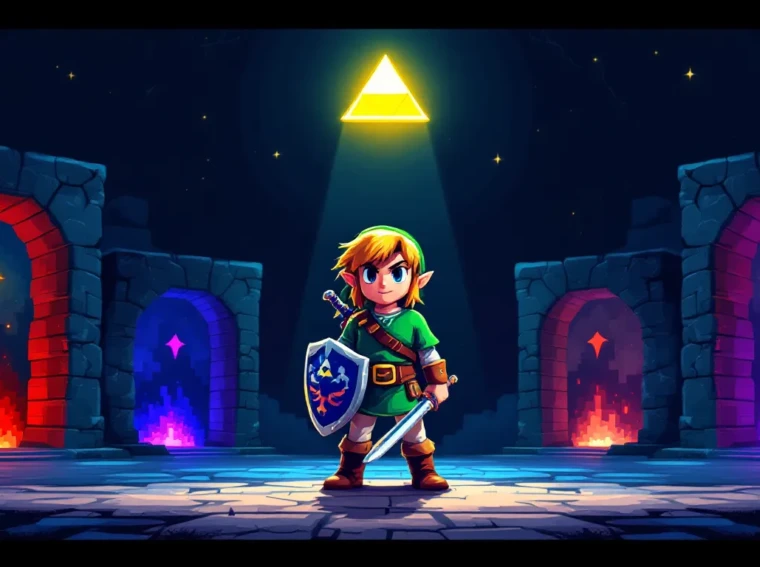
When Nintendo released the original Legend of Zelda on NES in 1986, it didn’t just launch a franchise, it invented the action-adventure genre. This 8 bit masterpiece fundamentally changed how players thought about game design, exploration, and what a home console could deliver. The Legend of Zelda original stands as one of gaming’s most influential titles, and decades later, the NES Zelda still holds up remarkably well. Whether you’re revisiting this classic or experiencing the first Zelda game for the first time, understanding its design philosophy and mechanics reveals why the original Legend of Zelda game remains essential to understanding modern gaming.
Key Takeaways
- The Legend of Zelda on NES in 1986 invented the action-adventure genre by introducing open-world exploration and non-linear dungeon progression, fundamentally reshaping game design and console gaming.
- The original Zelda’s technical constraints (128 KB cartridge) forced brilliant design decisions—environmental storytelling instead of cutscenes and puzzles solved through interaction rather than tutorials—principles still used in modern games.
- Gameplay depth comes from resource management and pattern recognition: combat rewards understanding enemy behavior, puzzle-solving requires the right tools, and boss encounters demand both positioning and strategy.
- The Legend of Zelda NES earned respect for the player’s intelligence by trusting them to explore, fail, and learn without hand-holding, establishing a design philosophy that persists in modern titles like Breath of the Wild and Dark Souls.
- Decades later, the 8-bit Zelda remains mechanically brilliant and genuinely playable—not a museum piece—proving that thoughtful design, clear scope, and meaningful exploration transcend technological limitations.
History and Legacy of the Original Legend of Zelda
Development and Release
Shigeru Miyamoto and his team at Nintendo crafted Zelda 1 during a period when video games were still defining their identity. The project started in 1984, with the team experimenting with what a console adventure game could be. Unlike the linear, level-based structure of contemporary games, the original Zelda nes introduced players to an open overworld where exploration wasn’t just encouraged, it was rewarded.
The game launched in Japan on February 21, 1986, followed by a North American release in July of that year. It came on a gold cartridge, a visual distinction that signaled its importance. The Legend of Zelda original shipped with 6.5 million copies across its lifetime on the NES, making the original Zelda a commercial success before critics fully grasped its revolutionary design. The fact that you could wander almost anywhere from the start, tackle dungeons in a largely non-linear order, and discover secrets without hand-holding felt alien in 1986.
The cartridge’s 128 KB capacity forced brutal design decisions. The Legend of Zelda nes team couldn’t waste space on cutscenes or lengthy dialogue. Instead, they built a game where the environment told the story. A locked door meant you needed a key. A cracked wall suggested bombing it. This constraint became a strength, players learned through interaction rather than exposition, a principle that still influences adventure game design today.
Impact on Gaming Industry
The Legend of Zelda original didn’t just succeed commercially: it restructured how the industry thought about game structure. Before the first Zelda game, adventure games meant text parsers and static screens. After NES Zelda, adventure meant exploration, combat, puzzle-solving, and discovery in a unified space.
The impact rippled immediately. Games like Castlevania II expanded on the open-world formula Zelda pioneered. More critically, the original Legend of Zelda proved that home consoles could host games with depth, replayability, and genuine challenge. This credibility helped the NES become the dominant console of the late 1980s, essentially saving the entire industry from the 1983 crash.
Developers studying the 8 bit Zelda discovered principles that still apply: clear feedback systems, meaningful exploration rewards, escalating difficulty, and player agency. The game treated players as intelligent beings capable of solving problems without explicit instruction. That respect for the player’s intelligence became Zelda’s signature.
Modern franchises like Dark Souls, Breath of the Wild, and Elden Ring owe conceptual debts to what Miyamoto’s team established with the original Zelda game. The genre conventions these games break or subvert are often conventions that the first Zelda game originally created.
Game Overview and Core Mechanics
Gameplay and Combat System
The Legend of Zelda nes plays like a top-down dungeon crawler with an open overworld. You control Link, a silent protagonist whose only dialogue is the occasional “It’s dangerous to go alone.” (spoken by an old man, not Link himself). Combat is directional, you face the direction you’re attacking, and enemies do the same.
Your starting weapon is a wooden Sword, which feels fragile compared to the dangers ahead. Most enemies require multiple hits, and positioning matters. A Slime moving diagonally requires you to anticipate its path. A Moblin (an armored pig-soldier) can’t be killed from the front with the basic sword, you need either bombs or a better weapon. This taught players that combat wasn’t about button mashing: it was about understanding enemy patterns and using the right tool.
The combat system’s simplicity masks surprising depth. Some enemies can only be killed with specific weapons. The Blade Traps that appear in later dungeons can’t be destroyed, you must navigate around them. Bosses require pattern recognition. The Aquamentus boss in the first dungeon breathes fire in a spread pattern: you circle around and strike when it’s vulnerable. This isn’t difficult by modern standards, but it established the boss-design language that persists in Zelda games today.
You have limited health (represented by heart containers), limited magic for special items, and no way to replenish resources except by finding them in the world or visiting specific locations. Resource management becomes a tactical layer. Using your Sword conserves magic. Using Fire (your magic projectile) is expensive but faster. Understanding these tradeoffs is how you progress from struggling newcomer to competent adventurer.
Exploration and Puzzle-Solving
The overworld is your first puzzle. You start with nothing but a sword and a vague directive to rescue Princess Zelda. The old man hints that you should find a dungeon. But which one? The overworld has ten dungeons scattered across it, and you can technically try any of them. Most players find the first dungeon in the upper-left area, it’s the easiest, but you could skip it and head elsewhere.
This non-linearity was radical. Games like Super Mario Bros. had linear progressions with set difficulty curves. The Legend of Zelda nes trusted players to make meaningful choices about their path. If you wander into Dungeon 7 before collecting the necessary items, you’ll get stuck. But you’ll learn where items are located, what you need, and you can return when you’re ready.
Dungeons themselves are intricate. Each room presents a problem: How do you cross the spiked pit? Which enemies must you defeat to open the door? What does the crack in the wall mean? Many puzzles require specific items. The Bombs let you destroy walls and objects. The Ladder lets you cross water. The Raft moves you to new areas. The Recorder (found in Dungeon 8) opens doors blocked by statues.
Puzzles escalate logically. Early dungeons present straightforward challenges: destroy enemies, move through the room, open the door. Later dungeons layer multiple solutions. A single room might require you to bomb the wall, defeat enemies in a specific order, use a special item, and solve a spatial puzzle, all in sequence. This teaches problem-solving skills progressively.
The genius of the Legend of Zelda original is that none of these solutions feel arbitrary. A cracked wall looks destructible, so you bomb it. A block-shaped character in a dungeon looks pushable, so you try moving into it. The game communicates through its visual design, not through on-screen prompts or tutorial text.
Walkthrough: Dungeons and Progression
Early Game Dungeons and Strategies
Dungeon 1 (Labyrinth) is the intended starting point. Located in the top-left corner of the overworld, it introduces basic mechanics: defeating enemies opens doors, pushing blocks reveals items, and the boss (Aquamentus, a fire-breathing dragon) teaches you pattern recognition. The Bow found here becomes a key tool. Strategy: Keep the Sword for groups of enemies, use the Bow for distant threats, and stock Bombs before the boss fight.
Dungeon 2 (Moon) requires the Bow from Dungeon 1. It introduces the Recorder (in a side chamber) and teaches you that dungeons have multiple solutions. If you miss optional items, you can return later. The Armos statues throughout the overworld will react to the Recorder, opening shortcuts. Boss (Dodongo, a multi-part enemy) is easier if you have Bombs.
Dungeon 3 (Manji) sits in the top-right area and requires specific items from Dungeons 1 and 2. By now, you understand the pattern: defeat enemies, solve puzzles, collect treasure, defeat boss, obtain the Triforce Piece. Each dungeon gives you one piece of the Triforce (the game’s victory condition, collecting all nine pieces opens the final area).
Early-game strategy: Hoard Bombs because they’re precious. The Blue Ring (found in Dungeon 1) reduces damage taken: grab it if you find it, but don’t waste time hunting. The Sword can be upgraded to the White Sword (found in the overworld) and later to the Magical Sword (in Dungeon 9). Weapon progression mirrors difficulty escalation.
Mid-Game Challenges and Item Collection
By Dungeons 4-6, the game expects you to manage complex combat situations and multi-stage puzzles. Dungeon 4 (The Gohma) is in the center of the map and introduces enemies that require specific killing methods. The Dimple enemies here can’t be harmed with the sword, only bombs work. This forces players to adapt their approach.
Mid-game is where you optimize your arsenal. You now have choices: use the Bow or the Sword? Use Bombs or the Blue Ring for defense? Decisions carry weight because resources are finite. The Magical Rod (from Dungeon 4) lets you cast Fire spells, replacing the expensive magic bottles as your projectile option.
Dungeon 5 (The Lion) sits in the bottom-left and is notoriously confusing, its layout doesn’t follow the typical pattern, and players often get lost. This is intentional. Not all dungeons follow the same structure, which reinforces exploration as a core mechanic. You must map the layout yourself, understand the geography, and adapt. The Magical Key found here opens doors without consuming keys, fundamentally changing how you navigate subsequent dungeons.
Dungeon 6 (The Demon) requires the Raft (from Dungeon 5) to even enter. It’s positioned on an island, establishing that progression isn’t just about combat strength, it’s about unlocking access. The Magical Wand found here enables new spell options.
Mid-game item collection checklist: Magic Bottles (for recovery), Keys (for doors), Maps (for each dungeon), Compasses (for dungeon navigation, very useful). The Pegasus Boots (found in the overworld, usually near Dungeon 6) let you run, making navigation faster. Smart players use the Pegasus Boots to farm items and explore efficiently.
Late Game Dungeons and Boss Encounters
Dungeons 7, 8, and 9 form the final tier. Dungeon 7 (The Aqua) requires the Raft to reach its island and demands proficiency with all your tools. Enemies here hit harder, and puzzles are multi-layered. The Book of Magic lets you upgrade your Magical Rod to Level 2, doubling its damage.
Dungeon 8 (The Lion, confusingly named the same as Dungeon 5 in some translations) is where the Recorder reaches its full potential. Statues that block paths now yield to its power. Puzzles here require the Recorder in combination with combat and bombing. The Silver Arrows found here are critical for the final boss, they’re the only weapon that damages Ganon effectively.
Dungeon 9 (Death Mountain) is the final dungeon. It’s brutal. Enemies appear in overwhelming numbers. Rooms demand precision. But by now, you have all your tools: the Magical Sword, the Blue Ring, Magic Bottles, the Silver Arrows, and the knowledge of how to solve the game’s challenges.
The final boss, Ganon, is a three-phase encounter. In phase one, he’s invisible, you must have the Blue Ring equipped or he’ll one-shot you. The Silver Arrows are your only damage source. Phase two has him charge at you. Phase three forces you to combine what you’ve learned about positioning and targeting. It’s the culmination of everything the game taught you.
Late-game strategy: Stock at least 30 Bombs, max out your health (collect all Heart Containers), and ensure you have full Magic Bottles. The optional Blue Ring upgrade in the overworld makes the endgame significantly easier. Don’t waste time on optional challenges unless you’re confident, the final dungeons demand your full arsenal and attention.
Essential Items and Power-Ups
Weapons and Tools
Your arsenal in the Legend of Zelda nes is your toolkit for problem-solving. The Sword is your baseline, every room can be solved with it, but not efficiently. Upgrading to the White Sword (found in the overworld) doubles damage. The Magical Sword (Dungeon 9) doubles it again and shoots Beam projectiles when you’re at full health. By late game, the Magical Sword is almost necessary.
The Bow is your ranged option. It costs Magic (measured in smaller units than spell-casting), and each arrow uses a fraction of your magic pool. Early game, the Bow feels expensive, so players tend to avoid it. Late game, with upgraded Magical Rods and Magic Bottles, the Bow becomes a reliable tool for distant enemies.
Bombs are your breaker tool. They destroy cracked walls, kill enemies immune to swords, and solve spatial puzzles (you push them toward buttons). You carry limited Bombs (starting at 4), but you can upgrade to 8, 12, and 16 by finding upgrades in the overworld. Hoard Bombs, they’re finite and essential. A player who runs out of Bombs before Dungeon 9 faces significant difficulty.
The Magical Rod and its upgrades (Level 2 from Dungeon 8) cast Fire spells. Fire is expensive but rapid. It’s your best tool when surrounded by enemies. By endgame, a fully upgraded magic system (maxed Magic Bottles + Level 2 Magical Rod) makes combat far more manageable.
Special weapons like the Recorder (really a flute) don’t deal damage, they open doors and affect the overworld. The Book of Magic doubles your Magical Rod damage. The Candle lets you see in dark rooms and burn bush obstacles. The Whistle (an alternative to the Recorder in some playthroughs) warps you out of dungeons instantly, though it’s optional.
Special Items and Their Uses
The Blue Ring is defensive tech that halves damage taken. You start finding it in Dungeon 1, and it remains the only damage-reduction item in the game. Late game, it’s not optional, it’s survival equipment.
The Raft and Ladder are movement tools. The Raft carries you across water to otherwise-unreachable areas. The Ladder lets you cross water on the overworld map. These aren’t weapons, but they’re progression gates. Without the Raft, you can’t reach Dungeons 6, 7, or 8.
The Pegasus Boots are arguably the best quality-of-life item in the game. They let you run (holding the button), making exploration and farming much faster. Players who rush to grab the Pegasus Boots early save themselves hours of slow walking.
Magic Bottles store potions, Red Potion recovers health (full recovery), Blue Potion recovers magic, and Green Potion clears status effects (though status effects are rare). You can carry up to 16 bottles by late game. Smart resource management means keeping Red Potions for boss fights and Blue Potions for magic-heavy rooms.
Triforce Pieces are your victory condition. Collect all nine, and the game’s final dungeon opens. Each dungeon boss grants one piece. You can’t progress without them, and they drive the narrative structure.
The Silver Arrows are unique, they deal damage to Ganon when nothing else will. Found in Dungeon 8, they’re essential for the final boss. You get enough to win, but if you waste them on lesser enemies (which you shouldn’t), you’re in trouble.
Tips, Tricks, and Advanced Strategies
Efficient Resource Management
The Legend of Zelda original punishes waste. You have a finite number of Bombs, limited magic, and no way to “farm” without returning to specific locations. Efficient players manage resources ruthlessly.
First, identify which enemies actually threaten you. Small Slimes and Gels die to one Sword hit, don’t waste Bombs on them. Moblins and armored enemies demand Bombs or better weapons, plan encounters accordingly. Room design often hints at the intended approach. A room full of Bombs scattered on the ground suggests bombing enemies rather than sword-fighting them.
Second, optimize dungeon runs. Map the layout in your mind or on paper. Identify chests containing Keys, Bombs, and Heart Containers. Prioritize collecting Heart Containers, each one expands your health pool by a half-heart, and more health absorbs more mistakes. A late-game run where you’ve collected 12+ Heart Containers is vastly easier than one where you’ve neglected them.
Third, understand item economy. Magic Bottles are the most valuable resource. The Blue Potion fully restores magic, letting you cast spells continuously. By late game, if you have three Blue Potions and the Magical Sword, you can sustain through almost any encounter. Conversely, a player who uses magic carelessly will run dry and be forced to rely on the Sword alone.
Advanced players abuse certain mechanics. The Pegasus Boots let you push Bombs faster, which is useful for bomb puzzles. You can get the Pegasus Boots early and use them to farm items, run around the overworld to respawn enemies, kill them for resources, and convert those into health or magic via potions. It’s tedious, but powerful.
You can also skip dungeons with puzzle solutions. A locked door in Dungeon 3 might seem impassable without a key, but if you bomb a crack in the wall elsewhere in that dungeon, you bypass the lock entirely. Learning these alternate routes saves time and resources.
Secret Areas and Hidden Treasures
The Legend of Zelda nes is stuffed with secrets. Some are story-critical (like the Silver Arrows), while others are quality-of-life improvements (extra Heart Containers, Bomb upgrades). Experienced players know where to look.
The overworld hides secrets under bushes, inside rocks, and within trees. Bombing cracked walls reveals passages. Burning specific bushes with the Candle opens paths. The game teaches you these interactions through environmental design, if a wall looks different, it’s probably breakable.
The White Sword is hidden in a secret chamber in the underworld. You need Bombs to access it. Early access to the White Sword makes mid-game significantly easier because you deal double damage.
The Magical Sword is in Dungeon 9, so you get it near the end, but you can theoretically sequence-break and grab it earlier if you know the exact route. This requires items you don’t have yet, so it’s an endgame-only trick.
The Blue Ring upgrade (some dungeons have alternate versions of the ring) is hidden in hard-to-reach locations. Finding it requires using all your tools creatively. The payoff is proportional, a fully upgraded Blue Ring that halves all damage is a game-changer for the final dungeons.
Ghost-player-created maps exist that show every secret location. But the game rewards systematic exploration. If you thoroughly bomb every wall and burn every suspicious bush, you’ll find most secrets organically. The developers didn’t hide them arbitrarily: they placed secrets where curious players would look.
One meta-secret: the developer’s room. By entering specific warp points in sequence, you can access a hidden area with the developers’ names. This was a cheeky reward for dedicated players before secrets were standard in games. It’s not necessary for progression, but it’s a nice callback to gaming’s arcade era, when high-score chases and Easter eggs were how players showed mastery.
For a comprehensive overview of modern gaming across multiple platforms, resources like GameSpot’s game guides provide updated walkthroughs for classic titles as well as contemporary releases. Players interested in understanding gaming culture and industry history will find Kotaku’s features on classic games invaluable for context and analysis.
Graphics, Sound, and Atmosphere
The Legend of Zelda nes looks primitive by 2026 standards, but it was cutting-edge for 1986. Sprites are simple, Link is recognizable but faceless, enemies have clear silhouettes that communicate their threat level, and dungeons are color-coded for visual clarity. The art direction compensates for technical limitations through intentional design.
Dungeons use color schemes as navigation aids. The red-themed dungeon looks different from the blue-themed dungeon, so you develop spatial intuition. Enemies in the blue dungeon are more aquatic-themed, reinforcing the environment’s identity. The visual consistency makes dungeons feel cohesive even at technical resolution of 256×240 pixels.
The color palette itself tells a story. Dark dungeons (lit only by your Candle) feel claustrophobic and oppressive. The bright overworld feels open and inviting. This contrast was deliberate, the game’s visual design communicates tone without dialogue.
Koji Kondo’s soundtrack is minimalist but unforgettable. The main theme is simple, a few notes that loop, but it’s instantly recognizable 40 years later. The dungeon theme builds tension with chromatic progression. The boss theme is ominous and frantic simultaneously. Each area has a distinct musical identity.
The music’s technical simplicity reflects NES hardware limitations (three simultaneous voices, including drums). Kondo worked within these constraints to create compositions that feel complete even though the limitation. Modern coverage often notes that the music’s simplicity is part of its charm, it lets players focus on gameplay while providing constant, subtle emotional cues.
Sound effects are minimal but effective. The sword strike has a distinct “tink” sound. Enemies make creature noises. The door-opening sound communicates success. There’s no voice acting, no dialogue, just environmental audio that reinforces your actions and their consequences. This created a design precedent: games can tell stories through environmental feedback rather than exposition.
The atmosphere of the original Zelda nes is lonely and exploratory. You’re a silent hero in a sparsely populated world, discovering secrets and dungeons. There’s danger, monsters lurk, bosses block your progress, but also beauty. The landscape feels vast for an 8-bit game. The occasional NPC (the old man, the shopkeeper) provides minimal guidance, forcing you to interpret the world yourself.
This atmospheric tone influenced action-adventure games for decades. The isolation, the emphasis on environmental storytelling, and the minimal narrative framework became conventions that games like Dark Souls would later subvert. The original Zelda game created those conventions.
Comparison with Zelda II and Modern Zelda Games
Zelda II: The Adventure of Link (1987) was Nintendo’s direct sequel, and it took radical risks. It shifted perspective to side-scrolling action-RPG. Combat became more complex (you leveled up skills like Sword, Magic, and Life). Dungeons were smaller and more linear. The overworld became a side-scrolling puzzle itself.
Zelda II was commercially successful and critically respected, but it felt like a departure from the original Zelda’s design philosophy. Where the first Zelda nes encouraged non-linear exploration, Zelda II funneled players more strictly. The 8 bit Zelda II had charm, but it didn’t redefine the formula the way its predecessor did.
The original Legend of Zelda game’s design principles, but, persisted. A Link to the Past (1991) returned to the top-down perspective and open-world structure. It refined what the original Zelda started: exploration, non-linear dungeons, and environmental puzzles. SNES developers studied the original Zelda nes and built on its foundation rather than reinventing it.
Skipping forward to modern Zelda games, Breath of the Wild (2017) and Tears of the Kingdom (2023) represent a full-circle moment. Both games return to the Zelda 1 philosophy: give the player freedom, minimal guidance, and a massive world to explore but they want. You can beat dungeons in almost any order. You can skip the main quest to hunt for secrets. The game respects your agency.
This is a deliberate callback to the original Legend of Zelda’s design. Modern Zelda leads acknowledge that the original Zelda game nailed something fundamental, player choice creates engagement. The first Zelda game trusted players to figure things out. Breath of the Wild and Tears of the Kingdom echo that trust across a modern, massive scale.
Occarina of Time (1998) and Twilight Princess (2006) took a middle ground. They had linear progression disguised as player choice. Certain items unlocked certain areas, creating a more railroad-like progression path even though the illusion of freedom. This works mechanically, but it abandons the original Zelda nes philosophy of “the player can try anything.”
Skyward Sword (2011) was even more linear, turning Zelda into a more narrative-driven experience with scripted progression. It’s a great game, but it moves furthest from the original Zelda’s design DNA.
The legend of Zelda original’s influence is measurable in how modern Zelda games oscillate between structure and freedom. Every few generations, the series swings back to the original Zelda’s design principles, proving that the core design remains sound. Developers like those reviewing and analyzing Zelda titles on Destructoid regularly note how Breath of the Wild’s design echoes the first NES Zelda’s trust in player agency, a callback 30 years after the original legend of Zelda game defined the genre.
Why The Legend of Zelda Remains Essential Today
The Legend of Zelda nes hasn’t aged as much as it’s ripened. Yes, it’s technically primitive, limited colors, simple sprites, audio limited to three channels. But the design? Still impeccable.
Modern games are often over-complicated. Quest markers point you to objectives. Tutorial text explains every mechanic. NPCs telegraph solutions. The first Zelda game did none of this, and its design clarity makes it more playable in 2026 than many 2020s titles.
Part of this is intentional minimalism. The original Legend of Zelda nes couldn’t hold your hand because the hardware didn’t support lengthy dialogue or complex UI. This technical constraint became a design strength. The game respects your intelligence. It teaches through environment, not exposition.
Another part is the game’s scope. The original Zelda 1 is “only” about 15-20 hours for a thorough playthrough, but it doesn’t feel small. The nine dungeons, the expansive overworld, the secrets and hidden items, it all feels substantial. Modern open-world games sometimes confuse size with content, padding vast maps with repetitive tasks. The Legend of Zelda original designs every room with purpose.
The combat, while simple, has surprising depth when you engage with it seriously. Dodging enemy patterns, understanding which tools counter which enemies, managing resources, these create genuine challenge without artificial difficulty spikes or cheap mechanics. You feel the game is fair. When you die, it’s because you made a mistake, not because the game cheated.
Playability is crucial. The original Zelda nes is still fun to play. It’s not a museum piece you interact with for historical curiosity. It’s a playable, challenging, rewarding game that holds up against modern indie titles with modern aesthetics. That’s the ultimate measure of design excellence.
The Zelda 1 NES game remains essential because it’s a master class in design clarity, scope management, and respecting the player. Every design choice serves the game’s core experience. Nothing is wasted. Nothing is arbitrary. The legend of Zelda original became timeless not even though its constraints, but because its designers turned constraints into strengths.
For modern gamers, the original Legend of Zelda game is a reminder that good design transcends technology. A game designed with care, where every mechanic teaches something, where exploration has meaning, where resources have weight, will outlast flashier contemporaries. The first Zelda game is a foundational text for game design, and playing it teaches lessons you’ll see echoed in games you play today.
Conclusion
The Legend of Zelda on NES is more than a classic game, it’s the blueprint. Released in 1986, the original Zelda NES established conventions that still define adventure games 40 years later. The 8 bit Zelda proved that home consoles could host games with depth, exploration, and meaningful player choice. Zelda 1 taught developers that constraints inspire creativity.
Whether you’re revisiting the original Legend of Zelda game as a nostalgic blast from the past or experiencing the first Zelda game for the first time, the design fundamentals hold up. The NES Zelda original remains challenging without feeling unfair. Its dungeons demand problem-solving. Its overworld invites exploration. The legend of Zelda original trusted players to figure things out, and that respect is why the original Zelda game endures.
The journey through dungeons one through nine, collecting Triforce Pieces and upgrading your arsenal, is still worth taking. The original Legend of Zelda game is accessible, play it via the NES cartridge, emulation, or modern re-releases on Nintendo Switch. No matter how you access the original Zelda, the experience is fundamentally intact.
If you want to understand why modern games are designed the way they are, play the original Zelda game. The legend of Zelda nes isn’t just historically important, it’s mechanically brilliant. And that brilliance is why this 8 bit masterpiece will remain essential long into the future.